Showing posts with label music. Show all posts

Friday, February 24, 2017

'Early in the Morning' - C.W. Stoneking

"Well I'm never goin back, to that country again,
If I live for a long, long time,
Where my guitar played itself, leanin by the wall,
It give me a worried mind"


The first song by C.W. Stoneking I remember hearing was The Marching of the Drum, a song that was popular in Ann Arbor for ballroomin' (also elsewhere, but I'll keep to immediate experiences). I always assumed, based on the 'faded' quality of the recording that C.W. Stoneking was some obscure artist who recording in the 40s. As usual, my initial assumptions were incorrect. The ragged, weary voice and mournful plucking of the guitar that comes through on 'Early in the Morning' is actually that of a contemporary Australian. He varies how he records his music to get that almost stereo-typically vintage sound of his album Jungle Blue, of which 'Early in the Morning' belongs.

I enjoy 'Early in the Morning' for two reasons. The first, it is simply a unique song to dance to, and secondly, it falls under a 'crossover' category in my DJ brain. As a dancer, I appreciate this song for its overall simplicity with rhythmic subtlety. Instruments come in almost in a round and the song ends the same way, with first the vocals, percussion, bass, and finally the guitar fading into silence. In my own movement this inspires light traveling, moments of suspension, and if my partner is feeling it with me isolation exploration with the banjo line.

As a DJ, I appreciated the versatility this sound brings to the floor. The picking in the banjo keeps a delta/country feel to my ear pervasive throughout the song. However, the bass line is a tuba-possibly sousaphone-chugging underneath the voice and guitar. These elements combine to make a song that allows me to shift gears to go deeper in a delta/country blues feel, or Jazzier as the case may be. It's a song that is hard not to DJ too much, lest it become stale.

C.W. Stoneking himself, as said before, is Australian. He was first introduced to blues by rummaging through his father's music collection and listening to Living With The Blues, an early blues compilation album. In the biography section of his website, Stoneking writes:

“When I first heard it I thought it was kinda funny music”, he told a Dutch interviewer a few years ago, “because it was so deconstructed and not really adhering to any rules that I’d been told music [should] fit into. And the more I listened to it, I just liked it more and more.”

C.W. Stoneking received many ARIA (Australian Recording Industry Association) Award nominations for Jungle Blues', eventually winning 'Best Blues and Roots Album' for Jungle Blues.

I was reminded of the Blues Dance World Podcast episode on the history of BluesSHOUT with Sara Cherny. She was musing on how blues dancing and the music has spread from the United States and been embraced the world over. Larger portions of the attendance of BluesSHOUT are made up of international dancers from European countries, Australia, and South Korea to name a few. Blues music and dance is appreciated the world over, and a young Australian really digging into that sound fits into the larger pattern.

I couldn't find any covers of this song, as it is an original composition.

Sources:
http://www.allmusic.com/song/early-in-the-mornin-mt0018683736
https://en.wikipedia.org/wiki/C._W._Stoneking
http://www.cwstoneking.com/
http://bluesdanceworld.com/2016/12/31/january-1st-2017-blues-dance-world-podcast-season-2-ep-09-a-decade-of-shout/

Tuesday, October 25, 2016

"It's Love Baby (24 Hours Of The Day)" - Ruth Brown

While in Grand Rapids in October I was inspired to dig into artist Ruth Brown thanks to a phenomenal swing & blues DJ, Andi Hansen. A song Andi loves to listen to is Ruth Brown's "It's Love Baby (24 Hours of the Day)". As a consequence, I really enjoy it too.


Ruth Brown first signed with Atlantic records. Throughout the fifties Ruth Brown had hit after hit on the Billboard R&B chart. According to Wikipedia, between 1949 and 1955 records by Brown stayed on the R&B chart for a total of 149 weeks: 16 top 10 records, along with 5 number one hits. During the sixties she receded from the public view to care for her family. In 1975 she came back to a musical career that eventually included winning a Tony Award as Best Actress in a Musical as well as a Grammy for Best Female Jazz Artist.

Other notable awards include:  recipient of the Pioneer Award (1989), inducted into the Oklahoma Jazz Hall Of Fame (1992), inducted into the Rock and Roll Hall of Fame (1993), and another Grammy nomination for R + B = Ruth Brown (1997).

Ruth Brown had hosted a program carried by NPR affiliates called BluesStage. I wasn't able to find any recordings of the program itself, but I did find an interview she did with NPR from 1993. In this interview Brown talks about her early life, admiration for Billie Holiday, and she sang as well while the host, Marian McPartland, accompanies on piano. One quality Ruth Brown highlights is the joy she injects into the songs she sings. In discussing Fine & Mellow she says she can't help but add more life and playfulness to the song than the Billie Holiday version, similarly with the song that got her inducted into the Rock and Roll Hall of Fame, "Mana, He Treats Your Daughter Mean".

According to Second Hand Songs the song itself was originally recorded by Louis Brooks and His Hi-Toppers in May of 1955. Brown's version was released in August of that year. I enjoy this song because of the energy. It's a driving song with a consistent rhythm section and a playful saxophone. There is a buoyant quality to her version that makes me want to dance (it's now going in the practice rotation).

Some Additional Versions:

It's love Baby - Earl Gaines with Louis Brooks & his Hi-Toppers

The Midnighters - It's Love Baby (24 Hours A Day)

Earl Gaines - It's Love Baby 24 Hours A Day

================
Sources
https://secondhandsongs.com/work/34960/originals#nav-entity
https://en.wikipedia.org/wiki/Ruth_Brown
https://www.rockhall.com/inductees/ruth-brown
http://www.npr.org/event/music/358587932/ruth-brown-on-piano-jazz

Sunday, April 15, 2012

The Religiosity of Music


“More than one hundred years before Beethoven, stone deaf, had heard the imaginary music of stringed instruments expressing his inmost thoughts and feelings. He had made signs with ink on ruled paper. A century later four Hungarians had reproduced from the printed reproduction of Beethoven’s scribble that music which Beethoven had never heard except in his imagination. Spiral grooves on a surface of shellac remembered their playing. The artificial memory revolved, a needle travelled in its grooves, and through a faint scraping and roaring that mimicked the noises of Beethoven’s own deafness, the audible symbols of Beethoven’s convictions and emotions quivered out into the air” (Huxley, 428)

I wrote a paper, it’ll be three years ago, about an ‘object’ that evokes a religious experience. Having never had a religious experience it was a difficult assignment. The class was advanced philosophy of religion and it was populated predominately by atheists and agnostics. There were a few religious people in the class, but interestingly enough none of the objects the religious chose to present on where actually affiliated with what someone might call established religion.

Many of us, well, nearly all of us, chose music. It was a trend the professor had noticed. Each year a greater percentage of his class would choose music as an object of religious experience. I would like to reflect on the why of those choices and possible motivating reasons.

I chose Rufus Wainwright’s version of the Agnus Dei. We were using Rudolf Otto’s book The Idea of the Holy as a model of dissecting what qualified as a religious object. The Wainwright song fit, at least to my mind, because of the emotions in invoked, its otherness, its darkness, the transition from minor and strange abruptly to a full and resounding major chorus. I was raised Catholic and so there is a very subjective reason why the song speaks to me. I used to sing the Agnus Dei, play it on trumpet and French horn. I used to be a musician in ensembles so I had a theoretical understanding of music. This personal experience led to the song being more meaningful for me than for others. Then again, this seems to be a hallmark of religious experience. It is deeply personal. It’s like jazz, “if you have to ask, you ain’t never gonna know”. There was something profound in its invocation, something that surely pointed to something other, something outside itself.

Music is problematic from a philosophical standpoint. On the one hand it is abstraction. The notes on the page stand for something, they’re at a remove from the immediate experience of hearing music. Moreover, there is not a principled reason (at least to my knowledge) why minor chords should sound sad or lonely. Why should certain frequencies (the one over period of oscillation) should have that quality when heard? At least, not unless there was something more to music than its playing and perception.

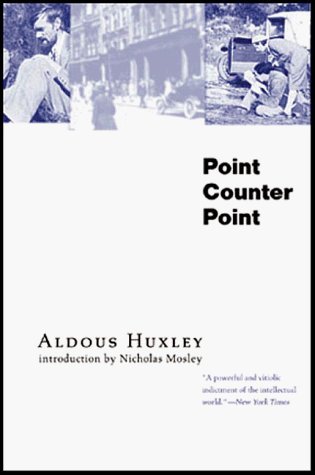
I’ve just finished Aldous Huxley’s Point Counterpoint. In the novel there is a passage where one character, Spandrell, is desperately trying to believe in or find God and his last argument, his last resource, is music. This argument is ruthlessly knocked down by Rampion, a man who has a very Nietzschean view of human nature, disagrees because he sees music as an attempt for man to be more than what man is. The argument becomes, and the same for religious experience, does it refer to something outside of itself. If I have a religious experience, does it mean anything outside of what I felt? Just because I had what could be called an otherworldly experience, does it refer in fact to something outside of the world?

The argument in music’s case, as far as Spandrell pushed it, was summed up in this question, “Did the music refer to nothing outside itself and the idiosyncrasies of its inventor?” (427). Rampion thinks that it does not. Music is music. It is personal, experiential, but just because it is does not mean that it points to anything beyond itself, anything beyond human experience.

Maybe the reason myself and so many of the nontheists in the class chose music as our religious object is because of this perceived disconnect. Spandrell I feel would agree with us. Choose music, it’s somehow holy even if we don’t believe in anything holy. It points to something other. Rampion would laugh at the whole class and our project. Good try students, but you’re looking for something that isn’t there. Music reduced is still just music. It doesn’t refer, nor should it. Even so, the immediate experience of it is powerful, even for us who really don’t believe much of anything in the way of religious reality.

If anything this post has just been a series of musings and nothing very substantial. Oh well I guess. It’s a theme I’d like to explore given more time, more reading, and more musings. Perhaps the next book on my list to read should be Godel, Escher, Bach.

Either way, enjoy Rufus Wainwright’s Agnus Dei.