Well...it has been quite awhile since I actually updated this.
This marks the beginning of an interesting year. Normally about this time, and by normally for the past 17 years of my life, the end of August means a return to school, be in elementary, middle, and high school, or back to the university. 74% of my Augusts have been spent returning to something.
This time, not so much.
New house, new roommates, new city, new friends, new schedule, new jobs, new expectations, new worries, new concerns. But hey, that's part of it, right? This whole growing up thing that we are all expected to do at some point in our lives. I'm just lucky this isn't the 1600s. Growing should have taken place when I was 15. Or even in my great grand parents time, the early 1900s, I should have been married by now. I suppose that's just as good, because in my great grand parent's family I would have been a pariah (a dancing, traveling, non-religious, person who enjoys a good craft beer on a summer night had no place in the strictly and formidably devout South Baptist family).
I will curtail this. A real post of my usual boring and pretension will follow soon. I wanted to, and still do, try to keep this philosophical, inquisitive, or a good place for a short rant which even as a rant I want to be somewhat useful for my own thought process.
Welcome to the real world, me!

Friday, August 17, 2012

Tuesday, May 29, 2012
Driving Suspension

The best part about night drives is the limbo. It isn’t purgatory. It isn’t even a kind of waiting really. It’s a suspension between decisions. Nothing has to be decided on, the course is
already set, the destination in mind, and if the driver is lucky the little
arrow will hover near full for miles, removing the need to stop.
Drivers don’t really even have to think anymore. We take our favorite songs on our iPods, mp3
players, old mix CDs. Podcasts on
economics, politics, humor, spare us having to have original thoughts. We need only listen and watch the world flow
around us.
At night there isn’t a lot to flow around. Especially traveling on those mid state
highways that pass between major cities separated not by tens but hundreds of
miles through small towns, farms, and pocket forests. Someone starting in a bustling city in the
afternoon, cursing rush hour traffic for keeping them from a destination four
hundred miles away where they have no set time or need to arrive quickly, can lose
even the other drivers on the road after turning of the interstate. Moreover, traveling alone, there will be
miles of highway without the rude glare of other headlights in the rearview, or
the telltale pinpricks of red taillights, like eyes, wandering back and away.
After three hours a driver can be pretty far into the limbo,
the suspension between places. The sun
which required the visors to be lowered, sunglasses to be donned, explicatives
to be uttered, is almost fully gone, leaving only traces of orange and purple
in a navy and deeply darkening sky.
From the four lane mid state highway a driver might turn
onto a smaller two lane state road that curves over hills and through farms (if
one is lucky enough to travel in the Midwest).
A driver rushes past sleeping houses, no lights visible inside, flies by
small, dying towns built around railroad lines which no longer stop or
care. Where do the people go? The grocery is boarded up. The car dealership sells cars, but no one is
ever there to look.
But the town is gone again and the last ten minutes of the
podcast is playing, or that part of the song that the driver always sings along
to, no matter how bad or out of tune the voice.
It could continue like that.
It could, really, in that suspension.
Experience is the only indication that the driver is getting close to
the end. The dark pinpoints of light cannot illuminate landmarks. The stars—old standards of navigation which
could have provided the necessary course having long since fallen out of use in
lieu of GPS and Google Maps--are only a part of the backdrop, the stage, the
setting. They move, but unperceptively,
unhelpfully.
And it’s not that the driver doesn’t want to arrive. Everyone wants to get to where they are
going. Eventually. Some are in more of a hurry than others. Maybe this time, the driver’s pulse quickens,
recognizing the last twenty minutes (distances measured in time, “how far is
this away from that?” “Oh, about twenty
minutes”), the courthouse of another county before the destination providing
the only point of illumination for ten minutes at sixty miles an hour in any
direction.
But the suspension, because the driver, me, I’m nearing the
end of it. Because waiting like that,
driving three hundred miles, a little over four hours doing over seventy miles
an hour and what’s more doing that in the evening, feeling the sunset and not
watching it, listening to This American
Life and Wait Wait, Don’t Tell Me! (I’m
a card carrying Liberal with a capital ‘L’) and my favorite music on the iPod I
got for Christmas two years ago, just the waiting, I don’t have to choose
anything. Not really.
Questions I had in my head at the beginning of the trip
resurface. The pulse, the crawling
feeling, the drumming fingers, impatience with the music because there aren’t
songs for this exact feeling, because
the limbo I was ok with because I didn’t think about it, that time is almost
over. In ten minutes I’ll be there, in
another place. A definite place, not an
idea at the end of some time on a road, but a definite, physically defined real
as far as we can tell series of sensations and facts that isn’t transitory but
NOW.
Because in two minutes I’ll put the car in park. I’ll turn the key and the low hum of the
engine with cease. The radio will be
silent, the music gone, the voices of National Public Radio quiet till the next
three hour trip. It will be me, and the car,
and some reality that for two hours flowed around me, not noticing, but
suspended.

Image from pragmaticcompendium.com
Tuesday, April 24, 2012
Interesting View of Earth: "Welcome to the Athropocene"
Firstly, I love maps. Relations are fascinating things to study, whether they be relationships between physical places, or more conceptual maps, like between ideas or people. To be honest, I'm not sure what this animation is supposed to portray. There is no verbal accompaniment, but the lights of the towns and cities as they stretch over the globe are thought provoking.
I do have one conjecture on what the spidery connections between cities over the water are. I imagine that they are shipping lanes as well as flight paths. It's interesting to me to see how interconnected the world is, and how far people have spread over its surface.
Monday, April 23, 2012
Signmark: Attending a Deaf (Literally) Rap Concert
On Sunday I attended an event I never thought I would
attend. I went to a deaf hip-hop/rap
concert given by Signmark, a deaf rapper.
My friends and I also danced while at the concert (a mix of lindy hop,
blues, and west coast) to his music. It
was a great deal of fun for us. Signmark
is a high-energy performer, made even more so by using ASL (American Sign
Language) to communicate the lyrics. He
has a counterpart who does the vocal lyrics, but Signmark composes the lyrics
and writes the beats himself.
The crowd itself seemed to be half hearing and half
deaf. It was surprisingly quiet. I was surprised at the variety of people who
knew ASL or used it to communicate. The
six foot five man in the biker jacket with the long white beard and American
flag bandana spoke only with his hands. A
knot of older women all signed quietly to each other, no sounds. Faces are also part of ASL grammar. It’s a very open language. You cannot hide what you’re trying to say,
and if you do try, you’re being rude.
One thing you, my reader, may wonder is “how do deaf people
enjoy a concert they can’t hear?”
Interesting question, and one for which I have an answer. Firstly, the speakers. They were powerful and very, very loud. For some in the deaf community, it isn’t so
much about hearing the music as it is about feeling it. They can feel the vibrations, especially of
the bass. Additionally, many people at
the concert, both hearing and not, had balloons. A balloon amplifies the vibrations from the
speakers. Holding the balloon makes it
easier to feel the music. I highly
recommend giving it a try.
The lyrics themselves were really clever. He rapped about deaf culture and deaf life,
about problems communicating, but also celebrating the culture and the benefits
of belonging. I’ve included two videos
of his songs below. I thought it was a great event and a great experience.
Friday, April 20, 2012
TED: Globalizing the Local, Localizing the Global
Yes, I'm a TED junkie. I thought this video about progressive movements in the Middle East, Qatar in particular, was very eye opening. I hope you will take the time to view it. It emphasizes the role of culture and identity in an increasingly global world where we struggle against what at times is a flood of pressure to conform to other's expectations of who we are and what we should be.
Thursday, April 19, 2012
John Haidt: Religion and Life
I've tagged this video because I think it emphasizes a point I've been trying to make. I am a nontheist (if you've read my blog at all you've figured this out). However, I am not a evangelical nontheist. Religion has been an important part of people's lives for over thousands of years. I personally don't have any use for it, you know this. However, I recognize that it does play a central role in the lives of others. So long as that leads to, what one might call, a liberal Christian interpretation of the Bible and the rights that are due to others as members of the species homo sapiens, then I have no beef with religion. It is when religion encroaches on democracy, when we can no longer talk to each other, do I get bothered. I feel the same about militant atheism. It is equally unproductive. That being said, enjoy the video. I feel we as atheists have a lot to learn from religion, and a duty to correct the mistakes made in the name of it.
Sunday, April 15, 2012
The Religiosity of Music
“More than one hundred years before Beethoven, stone deaf, had heard the imaginary music of stringed instruments expressing his inmost thoughts and feelings. He had made signs with ink on ruled paper. A century later four Hungarians had reproduced from the printed reproduction of Beethoven’s scribble that music which Beethoven had never heard except in his imagination. Spiral grooves on a surface of shellac remembered their playing. The artificial memory revolved, a needle travelled in its grooves, and through a faint scraping and roaring that mimicked the noises of Beethoven’s own deafness, the audible symbols of Beethoven’s convictions and emotions quivered out into the air” (Huxley, 428)
I wrote a paper, it’ll be three years ago, about an ‘object’ that evokes a religious experience. Having never had a religious experience it was a difficult assignment. The class was advanced philosophy of religion and it was populated predominately by atheists and agnostics. There were a few religious people in the class, but interestingly enough none of the objects the religious chose to present on where actually affiliated with what someone might call established religion.
Many of us, well, nearly all of us, chose music. It was a trend the professor had noticed. Each year a greater percentage of his class would choose music as an object of religious experience. I would like to reflect on the why of those choices and possible motivating reasons.
I chose Rufus Wainwright’s version of the Agnus Dei. We were using Rudolf Otto’s book The Idea of the Holy as a model of dissecting what qualified as a religious object. The Wainwright song fit, at least to my mind, because of the emotions in invoked, its otherness, its darkness, the transition from minor and strange abruptly to a full and resounding major chorus. I was raised Catholic and so there is a very subjective reason why the song speaks to me. I used to sing the Agnus Dei, play it on trumpet and French horn. I used to be a musician in ensembles so I had a theoretical understanding of music. This personal experience led to the song being more meaningful for me than for others. Then again, this seems to be a hallmark of religious experience. It is deeply personal. It’s like jazz, “if you have to ask, you ain’t never gonna know”. There was something profound in its invocation, something that surely pointed to something other, something outside itself.
Music is problematic from a philosophical standpoint. On the one hand it is abstraction. The notes on the page stand for something, they’re at a remove from the immediate experience of hearing music. Moreover, there is not a principled reason (at least to my knowledge) why minor chords should sound sad or lonely. Why should certain frequencies (the one over period of oscillation) should have that quality when heard? At least, not unless there was something more to music than its playing and perception.
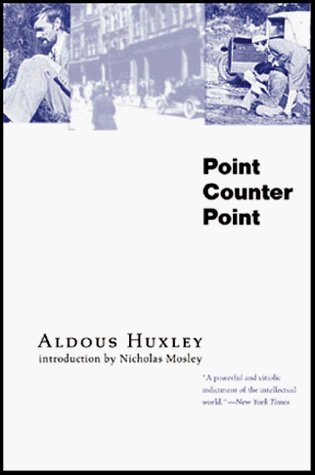
I’ve just finished Aldous Huxley’s Point Counterpoint. In the novel there is a passage where one character, Spandrell, is desperately trying to believe in or find God and his last argument, his last resource, is music. This argument is ruthlessly knocked down by Rampion, a man who has a very Nietzschean view of human nature, disagrees because he sees music as an attempt for man to be more than what man is. The argument becomes, and the same for religious experience, does it refer to something outside of itself. If I have a religious experience, does it mean anything outside of what I felt? Just because I had what could be called an otherworldly experience, does it refer in fact to something outside of the world?
The argument in music’s case, as far as Spandrell pushed it, was summed up in this question, “Did the music refer to nothing outside itself and the idiosyncrasies of its inventor?” (427). Rampion thinks that it does not. Music is music. It is personal, experiential, but just because it is does not mean that it points to anything beyond itself, anything beyond human experience.
Maybe the reason myself and so many of the nontheists in the class chose music as our religious object is because of this perceived disconnect. Spandrell I feel would agree with us. Choose music, it’s somehow holy even if we don’t believe in anything holy. It points to something other. Rampion would laugh at the whole class and our project. Good try students, but you’re looking for something that isn’t there. Music reduced is still just music. It doesn’t refer, nor should it. Even so, the immediate experience of it is powerful, even for us who really don’t believe much of anything in the way of religious reality.
If anything this post has just been a series of musings and nothing very substantial. Oh well I guess. It’s a theme I’d like to explore given more time, more reading, and more musings. Perhaps the next book on my list to read should be Godel, Escher, Bach.
Either way, enjoy Rufus Wainwright’s Agnus Dei.
Subscribe to:
Posts (Atom)